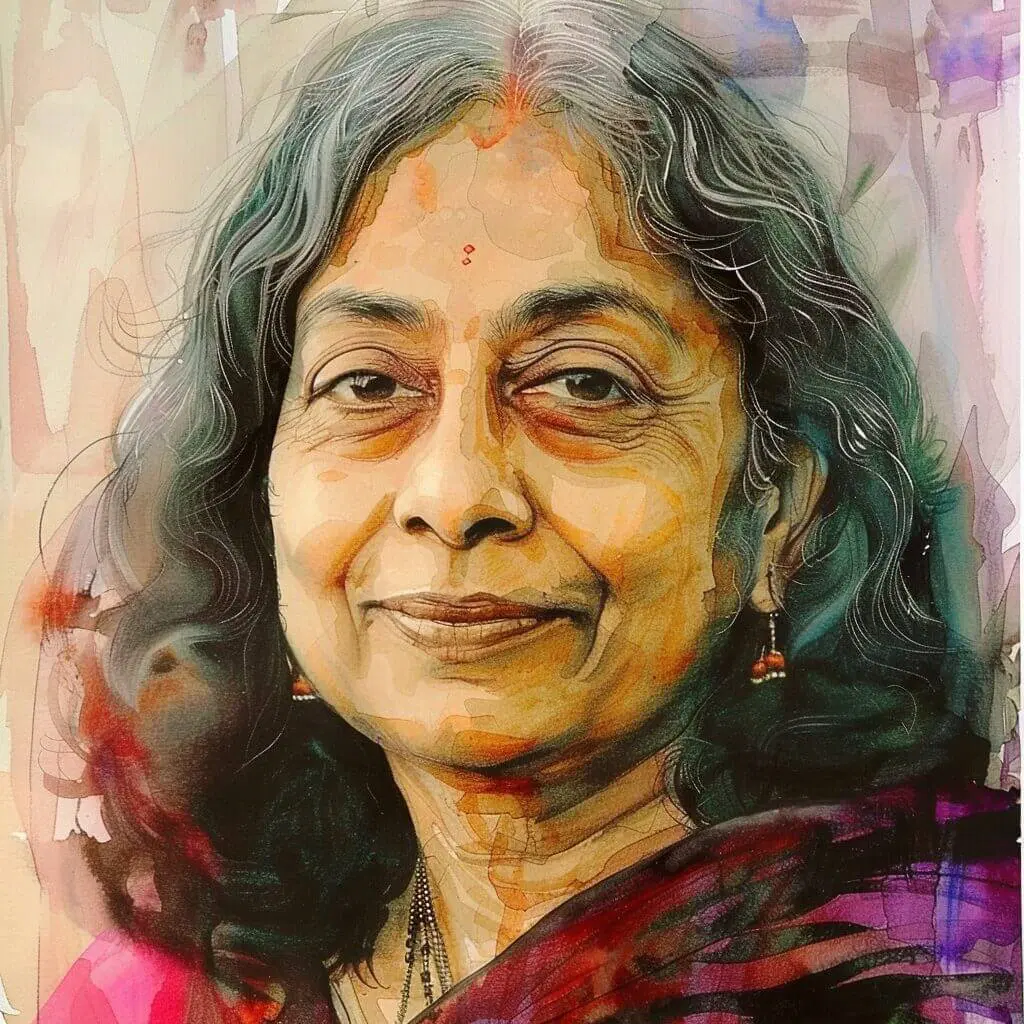
Kamala Das is remembered by her many names. But be it as Kamala Surayya, Madhavikutty, or Ami, her confessional poetry was ahead of time with its undisguised and uniquely Indian portrayal of female sexuality. She wrote both in Malayalam and English, her skill proving to be exemplary across the two languages. As a result, she translated some of her own work from one language to the other. Das was not stretching it far when she wrote, “I speak three languages, write in two, dream in one” (“An Introduction,” 1965).
Her oeuvre consists of short stories and poems. The most controversial of these was her memoir titled My Story. Das also wrote extensively on socio-cultural issues. Her work has been translated into multiple foreign languages like French and German.
About Kamala Das About Kamala Das

Interesting Facts
- Kamala Das was born in Malabar, Kerala, on March 31, 1934.
- Notable writers like Nalapat Narayana Menon and Nalapat Balamani Amma were members of her family.
- When Das was just six years old, she launched her very first magazine. One of her earliest poems in this magazine was about dolls left eternally headless.
- Das married young, but unlike most women of her era, she didn’t live a life devoid of intellectual stimulation. Her husband played a major role in introducing her to the larger literary community.
- Das’ conversion to Islam in 1999 and subsequent adoption of the name Kamala Surayya was the subject of many unwarranted debates at the time.
Famous Poems
- ‘My Mother at Sixty-Six‘ records a daughter’s fear about losing her mother, who she now notices has started to age. The poet tries to shift her focus away from this thought but the youthfulness of the world around her – in children and young trees – makes the contrast more obvious. Ultimately, she decides to keep her worries bottled up, wearing a smile on the outside.
- In ‘An Introduction‘, Kamala Das expresses anguish against the system that dictates her life and that of many other unfortunate women. The poet declares at the outset that she is acquainted with every male leader in India. The power of these men is contrasted throughout the poem with her lack of agency. Das supports giving all women the opportunity to choose in all aspects of their lives.
- In ‘The Sunshine Cat‘, the poet discovers that the men she loved were only using her to satisfy their own needs. She feels deceived by this. When her husband confines her to her room, the only comfort she can find is a ray of sunshine that peeks in like a yellow cat.
Explore more of Kamala Das’ poetry.
Early Life
Kamala Das was born in Malabar, Kerala on March 31, 1934. Her mother, Nalapat Balamani Amma, was a renowned writer and her father, VM Nair, an experienced journalist. Das’ great uncle, Nalapat Narayan Menon, was also an established writer. With stalwarts of such stalk around her, it was natural for her to take a liking to literature. She eventually outshone the legacy built by the writers in her family.
Das’ growing years were split between Kerala and Kolkata. When she turned fifteen, she was married off to her husband, Madhava Das, who was thirty at the time. Soon after, they shifted to Bombay. The couple had three children and a marriage that spanned forty-three years. Madhava Das was supportive of her creative pursuits. The years between them did not make too glaring an impact on their bond, but some believe that he was irked by the publication of her memoir.
Literary Career
When Kamala Das passed away at 75 in 2009, she left behind a grand body of work that spoke boldly about themes such as sexuality, love, marriage, and nostalgia. But the confessional nature of her work, at times, drew hyper-fixated attention to her personal life instead of the depth of her writing.
Das turned to writing as an interest early in her childhood, although her first published work, Summer in Calcutta, only came out in 1965. She once recalled watching her uncle write poems from dawn to dusk. To Das, this summed up the ideal life. With her brother, a six-year-old Kamala started a magazine. She would use this new-found medium to write strange and gloomy poems about headless dolls who were left so for eternity. Her brother would sketch out illustrations for these. She was also influenced by her mother’s work, although the latter’s preoccupation with the world of words made her an absentee in Das’ life.
After her marriage, Das’ husband nudged her to interact with those closer to her in age and with common interests. Albeit a patronising act, this opened Das up to a whole new world which shaped her writing. Madhava Das, on learning that his wife wanted to publish her work, was all for the decision because he felt the household could do with another source of income to bank on. Although Kamala Das began writing in Malayalam, much of her fame and global acclaim came through her English poetry.
Das’ poetic work was confessional. This genre, however, was not a favourite among Indian writers at the time. In fact, in her later years, Das even declared that poetry could not sell in India. Summer in Calcutta, Das’ first collection to be published, documented the trajectory of romance, describing its highs and lows. In this collection, she also included an autobiographical poem aptly titled ‘An Introduction‘.
Her memoir, My Story, roused a whole crowd of opinion in shock of the explicit portrayal of female sexuality. She was honest in her language and storytelling, although Das later declared that she had to weave in fictional elements to increase the book’s commercial value. If someone asked her why the memoir startled so many people, she would respond that the outrage was just a front for them to appear innocent. Das was simply turning a mirror to the reality around her.
Kamala Das was awarded the P.E.N.’s Asian Poetry Prize in 1963. In 1969, she also received Kerala’s Sahitya Akademi Award for her short story, Thanuppu. In 1985, she went on to win the National Sahitya Akademi Award too. Although shortlisted for the Nobel Prize for Literature in 1984, Das fell short of a win.
Personal Life and Controversies
Many critics define Kamala Das as controversy’s child. Her personal life was subjected to scrutiny especially after the publication of her memoir, My Story. She talked openly and honestly about her early years, her adolescence, her yearning and emotional struggles, and the maze of marriage and extramarital affairs that she had become entangled in.
Das wrote a great deal about romantic love and longing, but her own relationship with the former had been tricky. She has had more failures than successes in love. Such letdowns are captured in ‘The Sunshine Cat‘, demonstrating how the poet must have led a solitary, frigid life.
At 65, she converted to Islam, changed her name to Kamala Surayya, and walked out to the public wearing a purdah. This came as a complete shocker to most people.
Despite these controversies and a troubling relationship with love, Das’ work has endured the storm, maintaining her stature as a literary great.