

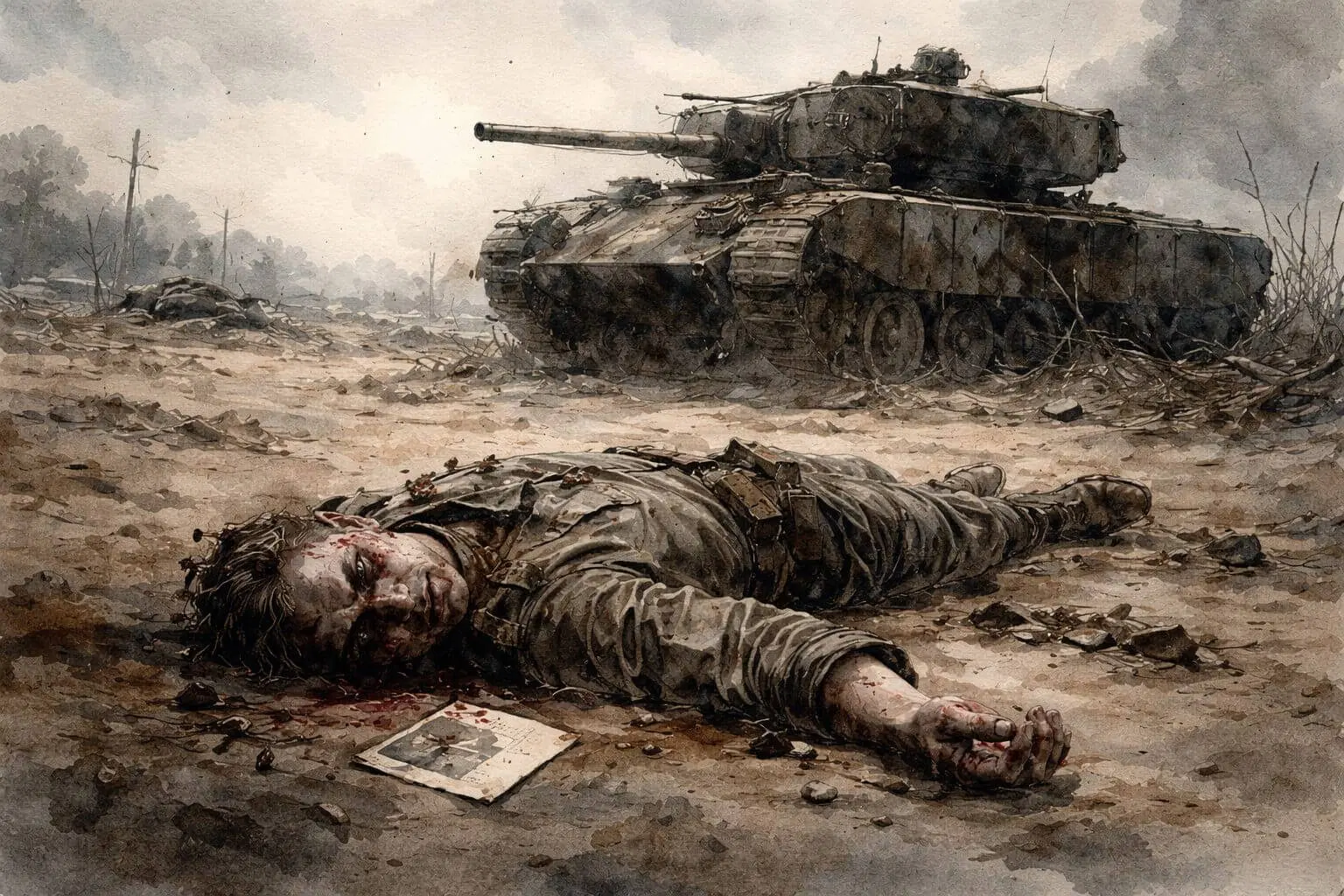

English soldiers return to the scene of a battle fought three weeks previously and find the dead body of a German soldier, which still lies in the sun and is now decomposing. Beside it lies a photograph of his girlfriend back home on which she has written the word, ‘Vergissmeinnicht’ (German for forget-me-not).
**4. Tips to Know Before Reading the Poem** Reading this poem requires a shift in attention away from action and toward what remains once events have already passed. The speaker is not caught in combat but revisiting its aftermath, so meaning develops through stillness, detail, and quiet reflection rather than excitement. Take note of how small objects and physical conditions carry emotional force without explanation. The controlled language mirrors emotional restraint shaped by repeated exposure to death. This restraint does not remove feeling but reshapes it. It is also important to accept that the poem does not offer comfort or resolution, instead asking the reader to sit with unease, contradiction, and the shared human cost of war.
Log in or join Poetry+ to access unlimited Poem PDFs.
Vergissmeinnicht Keith DouglasThree weeks gone and the combatants gone returning over the nightmare ground we found the place again, and found the soldier sprawling in the sun.The frowning barrel of his gun overshadowing. As we came on that day, he hit my tank with one like the entry of a demon.Look. Here in the gunpit spoil the dishonoured picture of his girl who has put: Steffi. Vergissmeinnicht. in a copybook gothic script.We see him almost with content, abassed, and seeming to have paid and mocked at by his own equipment that's hard and good when he's decayed.But she would weep to see today how on his skin the swart flies move; the dust upon the paper eye and the burst stomach like a cave.For here the lover and killer are mingled who had one body and one heart. And death who had the soldier singled has done the lover mortal hurt.

 Get PDFs
  Fully understand this poem faster with a
Poetry+
membership and get the core resources you need in one place
Fully understand this poem faster with a
Poetry+
membership and get the core resources you need in one place
Structure and Form
‘Vergissmeinnicht’ is set out in six stanzas of four lines each (quatrains). The rhyme scheme is irregular, with a full rhyme in some places and half-rhyme in others. This was a technique used by Wilfred Owens and is known as ‘pararhyme’.
The rhythm varies too, with seven, eight, or nine beats per line. It is mostly iambic tetrameter which, in turn, creates a steady, marching rhythm reflective of the soldiers’ movements. We can assume that the poet has deliberately avoided traditional rhythm and rhyme schemes to illustrate the upset, and reversal of norms caused by war. The same can be said for variations from the meter, such as the first line, ‘Three weeks gone…’ – this disrupts the meter and reflects upon the exhaustion of the soldiers.
The rhyme scheme varies, with the first stanza using ABBA, the second BCBB, the third DDEE, and the rest alternating (FGFG HIHI). The poem’s rhymes create a subtle musicality, reflecting both the monotony and chaos of war.
Tone
Although the tone is somber it is almost matter-of-fact about the soldier’s death, and almost devoid of pity, with the exception of stanza five with the reference to his girlfriends and how this sight would make her ‘weep’. A sense of world-weariness prevails: that this is just another casualty of war, and at least he belonged to the enemy’s side. The language employed is simple and unsentimental, but this in no way detracts from the message of ‘Vergissmeinnicht’, that war is bloody and brutal.
Analysis, Stanza by Stanza
First Stanza
Three weeks gone and the combatants gone
returning over the nightmare ground
we found the place again, and found
the soldier sprawling in the sun.
The poet sets the scene. A group of soldiers revisit the place of battle and find this soldier lying ‘sprawling in the sun’. This long sibilant description suggests a person in deep repose, savoring the sun’s rays and relaxing. But we know this cannot be the case since this was the scene of a vicious battle, ‘nightmare ground’ from which the combatants have fled. The use of internal rhyme and repetition of the words ‘gone’ and ‘found’ create a heavy effect, as though a bell is tolling to signify mourners. The fact that ‘gone’ and ‘sun’ do not completely rhyme, gives the verse an uneven feel. This is done deliberately to show the sense of confusion caused by warfare. The natural human reaction upon finding a body would be one of shock and grief but over-exposure to brutality has rendered these men indifferent, especially when this soldier is a German, thus the enemy.
Second Stanza
The frowning barrel of his gun
overshadowing. As we came on
that day, he hit my tank with one
like the entry of a demon.
The first two lines are confusing as we struggle to picture how the gun is overshadowing. The poet uses personification in ‘the frowning barrel of his gun’. Is this done to suggest that the gun has failed to protect him and is thus frowning? There is a further reference to this in stanza four. Next, the diction almost moves into the register of direct speech, as though the speaker in ‘Vergissmeinnicht’ is relaying to his comrades what happened on the day of battle, retelling it in simple monosyllabic language: “he hit my tank with one’. This makes the following simile more hard-hitting: ‘like the entry of a demon’ which shows the harsh and diabolic violence of war. The tone is interesting here as we wonder is the speaker trying to either take credit for having killed this enemy soldier as the first line of stanza four suggests: ‘We see him almost with content,’ or is he trying to justify why he had to kill him.
Third Stanza
Look. Here in the gunpit spoil
the dishonoured picture of his girl
who has put: Steffi. Vergissmeinnicht.
in a copybook gothic script.
Again here the direct speech carries on, as though the speaker is leading us, the readers, by the hand, as well as his comrades, to show us his handiwork. The full stop after ‘Look.’ is deliberately jarring as we stop to observe the scene. The line ‘gunpit spoil’ sounds almost clinical, The men now see the man for who he is, not just a random fighter on the opposing side, but a man with a private life and a sweetheart who loved him. However, the tone is still dispassionate although at least it is acknowledged that the picture has been ‘dishonoured’ lying beside or on the dead man, presumably sullied by the flies and his remains. Once more the absurdity and horror of war are shown in contrast to real life and her perfect writing in ‘copybook gothic script.’
Fourth Stanza
We see him almost with content,
abased, and seeming to have paid
and mocked at by his own equipment
that’s hard and good when he’s decayed.
This is a hard-hitting verse as it reflects the attitude of the onlookers, as they take in the scene before them without sadness or remorse. This is a dog-eat-dog world, the sense prevails that it is a them-or-us situation and rather him than them. In losing this battle he is now ‘abased’ as though he should feel ashamed for having succumbed to death, and this notion is magnified by his munitions. They remain: ‘hard and good when he’s decayed’. The consonance of the ‘ck’ sound in ‘mocked’ and then the hard ‘d’ sounds in placing ‘hard’ and ‘good’ together, are harsh and clipped suggesting that he deserved his fate. Conversely, we could think of the contrast between hard metal and soft flesh and the repercussions when they meet.
Fifth Stanza
But she would weep to see today
how on his skin the swart flies move;
the dust upon the paper eye
and the burst stomach like a cave.
Now the true horror of the scene is made explicit. The poet employs vivid imagery to show the extent of the soldier’s injuries. Hard-hitting graphic language is used to make us visualize the flies as they swarm around his face; the delicate skin around the eye is dried so it resembles paper, and finally the description of ‘the burst stomach like a cave’. This simile effectively shows how the shell of gunfire has hollowed out his stomach. He had no chance of survival.
Sixth Stanza
For here the lover and killer are mingled
who had one body and one heart.
And death who had the soldier singled
has done the lover mortal hurt.
In this concluding stanza of ‘Vergissmeinnicht’, finally, we feel some appreciation that the corpse which lies here, abandoned to the elements, was a person who meant something to others. It is impossible to differentiate between the soldier and the lover, for they are one and the same. The repetition of the statement ‘one body and one heart’ is moving and we feel that this is perhaps coming home to the soldiers here. The enemy here is seen as ‘death’, which is personified as having ‘singled him’. This could be interpreted as his killer shrugging off responsibility, war is war and it is death that takes life when it chooses. But there is a sense of pity expressed here for the girl, since in losing her lover, she too, has been done a ‘mortal hurt’.
About Keith Douglas
Keith Douglas, (1920-1944) was a blossoming young poet who was tragically killed in the Invasion of Normandy in 1944. In his poetry, we can see how he was inspired by the First World War poets Wilfred Owen and Siegfried Sassoon, in his direct use of language and unsentimental portrayal of the battlefields.
Themes
The poem presents war through moments that are calm on the surface but deeply unsettling when examined closely. Each idea that follows grows from the tension between human feeling and the harsh routines of combat, showing how violence reshapes the way people see life, death, and memory.
• Dehumanization
War is shown as a process that slowly removes personal identity and replaces it with habit and survival. When the soldiers return to the battlefield, the dead body is first treated as part of the landscape rather than as a person. This reaction feels learned rather than cruel, shaped by constant exposure to violence. The poem suggests that repeated contact with death trains soldiers to look without reacting, turning human loss into something expected and almost ordinary within the routine of warfare.
• Lost Love
The photograph of the soldier’s girlfriend interrupts the hardened outlook of the battlefield and reminds both the speakers and the reader that this man once lived a private life shaped by care and affection. The simple note written on the picture carries emotional weight because it belongs to a world untouched by violence. This contrast shows how war does not only end lives but also cuts short relationships, leaving love unfinished and unable to protect those it once sustained.
• Death’s Power
Death in the poem operates without reason or judgment, acting as an unseen force that chooses its victims without explanation. The soldier is not presented as brave or weak, only as someone who was selected by circumstance. This removes any sense of fairness or meaning from his end. By separating death from moral choice, the poem presents war as a space where survival depends more on chance than courage, and where human value holds little weight.
• Moral Conflict
The observing soldiers experience a quiet struggle between military thinking and human awareness. At first, there is a sense of acceptance, even satisfaction, that an enemy has fallen, yet the discovery of the photograph unsettles this stance. The poem captures this tension without resolving it, showing how war forces people to live with opposing feelings at the same time. Compassion is not absent, but it is restrained, shaped by fear, duty, and the need to keep moving forward.
• Memory
The presence of the word “Vergissmeinnicht” brings attention to the idea of remembering within a setting that encourages forgetting. While the battlefield erases lives quickly, the poem itself resists that erasure by pausing to acknowledge one fallen soldier as a whole person. Memory becomes an act of quiet resistance, offering dignity where none exists physically. Even as the body decays, the poem insists that attention and recognition can briefly restore meaning to what war tries to discard.
Poetic and Stylistic Techniques
The poem uses careful language choices to shape how the reader understands violence, memory, and emotional distance. Meaning is carried not only through what is described, but through how sound, comparison, and tone work together to reflect the mental world of soldiers.
• Imagery
The poem presents physical detail in a plain and controlled way that forces the reader to face the reality of death without comfort or distance. The body is described through decay, movement of flies, dust, and damage, which makes the scene feel unavoidable and real rather than symbolic or heroic. These details are not meant to shock for effect but to remove any false ideas about battle. By focusing on what remains after fighting ends, the poem shows how war reduces life to matter and silence.
• Symbolism
The photograph beside the dead soldier becomes a quiet but powerful object that represents the life he once had away from the battlefield. It stands for love, memory, and personal history, all of which are helpless against violence. The written word “Vergissmeinnicht” asks to be remembered, yet it lies next to a body already abandoned by war. This contrast shows how fragile human meaning is when placed against destruction, and how war leaves behind symbols that cannot restore what has been lost.
• Personification
The poem gives human qualities to objects and abstract forces in order to shift focus away from individual blame. The gun is described as frowning, and death is presented as something that selects its victim, which makes violence feel mechanical rather than personal. This device suggests that war itself operates with its own logic, independent of emotion or intention. By doing this, the poem shows how soldiers become part of a system where responsibility is blurred and killing feels distant from choice.
• Simile
Similes in the poem are brief but unsettling, linking violence to invasion and emptiness rather than action or bravery. The attack on the tank is compared to the entry of a demon, which frames combat as something corrupting rather than noble. Later, the damaged body is compared to a cave, suggesting hollowness and ruin. These comparisons deepen the sense that war does not build or defend but instead enters, destroys, and leaves absence where life once existed.
• Sound
The poem uses uneven rhyme and harsh sound patterns to create discomfort rather than smoothness. Half rhymes prevent the lines from settling, which mirrors the unstable world the soldiers move through. Repeated hard consonant sounds echo metal, impact, and stiffness, reinforcing the contrast between weapons and the human body. These sound choices support the emotional restraint of the poem and prevent it from becoming lyrical, ensuring that the reader remains aware of tension rather than beauty.
• Tone
The tone remains controlled, detached, and restrained, which reflects the emotional state of soldiers who have seen too much violence to react openly. Death is described without open grief, suggesting exhaustion rather than cruelty. This calm delivery makes the moment of imagined grief for the girlfriend more noticeable, as it briefly breaks through the emotional distance. The tone helps the poem avoid sentiment while still allowing space for recognition, showing how war teaches people to feel less while understanding more.
FAQs
The title means forget me not, a phrase closely linked with love, memory, and personal attachment. Its importance lies in how it contrasts sharply with the setting of the poem, where a dead body has been left to decay without care. The words ask for remembrance in a place that encourages forgetting, showing how war erases individuals even as loved ones hope they will be remembered.
The speaker’s calm description reflects the mental state of soldiers who have been surrounded by death for too long to respond with shock or grief. The body is treated as something expected rather than tragic, which shows how repeated violence teaches soldiers to distance themselves emotionally. This lack of response is not cruelty, but a survival habit shaped by the constant presence of danger and loss.
The photograph changes how the reader understands the dead man by reminding us that he once lived an ordinary life outside the battlefield. It represents connection, affection, and the world he came from, which now feels painfully distant. The note written on it shows care and hope, making the damage done by war feel wider, as it destroys not only bodies but also relationships and future possibilities.
Although the soldier is technically an enemy, the poem slowly removes any sense of personal blame. Violence is shown as part of a larger system where death acts without reason or fairness. By focusing on decay rather than combat, the poem suggests that all soldiers are equally vulnerable, and that war itself, rather than individual people, is the true force responsible for suffering.
The detailed focus on decay forces the reader to face the physical reality of what happens after fighting ends, without comfort or distance. These descriptions prevent the poem from becoming heroic or sentimental. Instead, they show how quickly the human body is reduced to matter, reminding us that war leaves behind silence and damage rather than meaning, glory, or lasting achievement.
The final stanza makes clear that the roles of soldier and lover cannot be separated, because they exist within the same person. When the man dies, both identities are destroyed at once. This recognition introduces a quiet sense of compassion, as the poem acknowledges that death harms not only the person who is killed, but also those who loved him and must live with that absence.