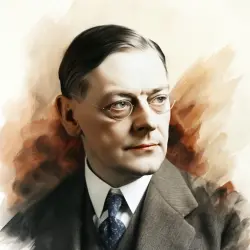




‘Whispers of Immortality’ by T.S. Eliot is an eight-stanza poem that was written between 1915 and 1918. It was first published in the September issue of Little Review and then was later included in Eliot’s volume, Poems, in 1919. Of the many quatrain poems written by Eliot, ‘Whispers of Immortality’ is one of the most popular. Upon an initial reading, it is clear that the poem is divided into two distinct sections, each containing four stanzas. The first contains a philosophizing statement in regard to death, and the second is materialism, sex, and love.
In addition to its formatting within sets of four lines, the poem is also structured with a casual rhyme scheme of abcb. There are a number of moments in which the rhymes are not precise, though. These are known as half or slant rhymes. A perfect example of this occurring is in stanza four, with the end rhymes “skeleton” and “bone.” There are similar consonant sounds in these words, but only to an extent. In regards to meter, the poem is mostly contained within iambic tetrameter. This means that each line contains four sets of two beats. The first of these is unstressed, and the second is stressed.
Log in or join Poetry+ to access unlimited Poem PDFs.

Whispers of Immortality T.S. EliotWebster was much possessed by death And saw the skull beneath the skin; And breastless creatures under ground Leaned backward with a lipless grin. Daffodil bulbs instead of balls Stared from the sockets of the eyes! He knew that thought clings round dead limbs Tightening its lusts and luxuries.Donne, I suppose, was such another Who found no substitute for sense, To seize and clutch and penetrate; Expert beyond experience, He knew the anguish of the marrow The ague of the skeleton; No contact possible to flesh Allayed the fever of the bone.Grishkin is nice: her Russian eye Is underlined for emphasis; Uncorseted, her friendly bust Gives promise of pneumatic bliss. The couched Brazilian jaguar Compels the scampering marmoset With subtle effluence of cat; Grishkin has a maisonnette; The sleek Brazilian jaguar Does not in its arboreal gloom Distil so rank a feline smell As Grishkin in a drawing room.And even the Abstract Entities Circumambulate her charm; But our lot crawls between dry ribs To keep our metaphysics warm.

 Get PDFs
  Fully understand this poem faster with a
Poetry+
membership and get the core resources you need in one place
Fully understand this poem faster with a
Poetry+
membership and get the core resources you need in one place

Summary of ‘Whispers of Immortality‘
‘Whispers of Immortality‘ describes the connection between life, death, love, and sex and how ultimately, death becomes the most important thing in life.
The poem begins with the speaker describing how John Webster, a dramatist, thought about life and death. He, as well as other writers such as John Donne, saw the truth of death beneath life. They were able to use their own knowledge to investigate deeper and discover its presence within everyone’s bones.
The second half of the poem introduces sex into life. There is one character of note, Grishkin, who is used as a representative of life and passion. She is a sexual person, but even when one enters into her breast, one will find cold bones and eventual death. The poem ends with the speaker describing how the study of the presence of death will become all-consuming.
You can read more about T.S. Eliot’s poetry here.
Analysis of Whispers of Immortality
Stanza One
Webster was much possessed by death
And saw the skull beneath the skin;
And breastless creatures under ground
Leaned backward with a lipless grin.
In the first stanza of ‘Whispers of Immortality’, the speaker discusses the beliefs and works of John Webster. He is best known today as a dramatist and author of ‘The Duchess of Malfi. He was a contemporary of Shakespeare and appealed to Eliot in how he got to the truth of a situation. The first line makes this clear as the speaker states that Webster was “possessed by death.” It was all he could think about; it consumed his thoughts. He was able to look past the masks set out over the world and down to the “skull beneath the skin.”
The speaker goes on to use another metaphor to describe Webster’s way of thinking. He could look “underground” at the strange and “breastless creatures.” These creatures are without hearts or human (or humane) intentions. This is a dark image, made more macabre by the image of a creature, which is actually an exposed human being, leaning back “with a lipless grin.”
Stanza Two
Daffodil bulbs instead of balls
Stared from the sockets of the eyes!
He knew that thought clings round dead limbs
Tightening its lusts and luxuries.
In the second stanza, the speaker expands on the sight of a skinless person. This same creature which lacks the outward appearance of humanity, has “Daffodil bulbs instead of…eyes.” This is another terrifying sight and is related directly to a play by Webster titled, The White Devil. Towards the end of that particular work, a ghost brings in a flower pot in which a skull is placed.
The next two lines are even stranger than those which came before them. The speaker describes how “He,” the one without eyes, relates death and thought, together with lust. It seems to him that sexual love is intimately connected to death. So much so it “clings” to the dead.
Stanza Three
Donne, I suppose, was such another
Who found no substitute for sense,
To seize and clutch and penetrate;
Expert beyond experience,
In the next four lines, the speaker turns away from Webster to discuss English poet John Donne. The speaker states that Donne was “such another” like Webster, who prioritized his senses. He was deeply engaged with his world and sought out all experiences. Through his thoughts, Donne came to know the world and, more importantly, realize the ever-present nature of death. He was an “Expert” in emotion and wrote penetratingly about the things he learned.
Stanza Four
He knew the anguish of the marrow
The ague of the skeleton;
No contact possible to flesh
Allayed the fever of the bone.
The fourth stanza makes clear that Donne had a good understanding of what death is and how important it is to one’s life. He understood the “anguish” that is part of one’s bones. It is an “ague,” or illness, deep within the body. So integral is humanity’s path toward death that it lives within one’s physical frame.
The next two lines explain that even though sex is tied to death, nothing can relieve or allay the terror of its coming. Eliot once more uses physical contact to illustrate his meaning.
Stanza Five
Grishkin is nice: her Russian eye
Is underlined for emphasis;
Uncorseted, her friendly bust
Gives promise of pneumatic bliss.
When Eliot gets to the fifth stanza, the poem changes. In its original form, the two sections were separated by five dots, denoting a change in the current topic but not the larger themes.
He immediately refers to “Grishkin.” This person is not well-known like Webster and Donne before her. It has been speculated that she was a Russian woman who was a “friendly” and sexual woman. In the poem, she uses her “eye” to emphasize what she’s saying and what she wants. The speaker also describes how when she is “Uncorseted,” or her corset is taken off, her “bust” gives out a “promise.” The bliss that she experiences and that which she gives is “pneumatic” or pressurized, as if powered by a machine. This phrase, “pneumatic bliss’ was coined by Eliot and has since been used to refer to a woman’s breasts.
Stanza Six
The couched Brazilian jaguar
Compels the scampering marmoset
With subtle effluence of cat;
Grishkin has a maisonnette;
In the sixth stanza, the speaker introduces another image, that of a “Brazilian jaguar.” He compares the cat to Grishkin and describes how she is about to “scamper” after a “marmoset.” The two are contrasted in their power. The marmoset is helpless at the hands of the jaguar. She moves with the “effluence of cat.”
The final line states that Grishkin has a small apartment or a “maisonnette.” The conspicuous placement of this line, after the focus on sex, suggests the apartment is dedicated to sexual escapades.
Stanza Seven
The sleek Brazilian jaguar
Does not in its arboreal gloom
Distil so rank a feline smell
As Grishkin in a drawing-room.
Although Grishkin was favorably compared with the jaguar in the sixth stanza, in the seventh, she overtakes it. Both, when they are in their native homes, whether in a “drawing-room” or the ”arboreal gloom” of the forest, smell distinctive. Grishkin obviously smells more favorably, in this case, “rank[er],” than the jaguar does. Its smell is less obvious, more “subtle.”
Stanza Eight
And even the Abstract Entities
Circumambulate her charm;
But our lot crawls between dry ribs
To keep our metaphysics warm.
The eighth stanza ends the poem with a strange yet clever conclusion. The speaker states that the “Abstract Entities,” or the essence of the world, circle around Grishkin. This philosophical language relates back to the earlier stanzas in which the speaker refers to “pneumonic bliss.” He states that “our lot,” meaning all human beings, from the speaker himself to John Donne and the reader, are doomed to “crawl between dry ribs.”
While there, searching for love, sex, passion, or a combination of all three, one is only able to find “metaphysics.” Metaphysics is defined as the study of the first principles of things. These principles include the concept of essences, as well as time, space, and knowledge itself. The truth of life’s closeness to death is all that will end up mattering. Everyone who follows this path will eventually dedicate their lives to the philosophizing Eliot has been engaging in for the last eight stanzas.