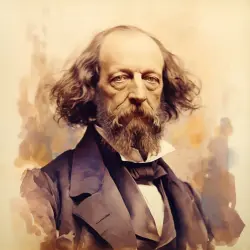


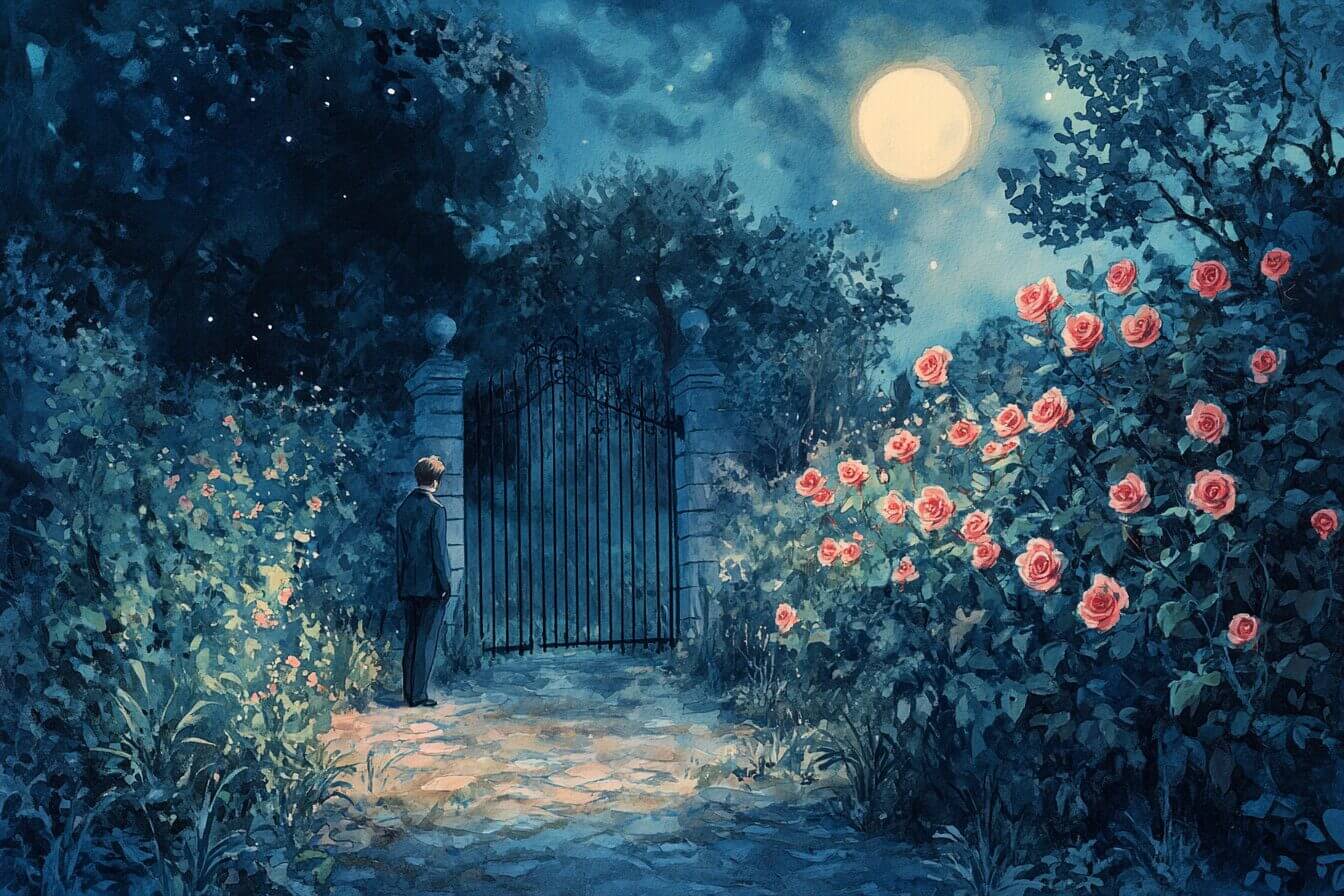

This piece is an excerpt from the longer work, ‘Maud’. The poem was published in Maud and Other Poems in 1855. Within ‘Maud,’ a larger story is told of the speaker’s father’s suicide, the speaker’s relationship with his neighbor’s daughter, Maud, and the series of disturbing events that follow.
In this section of the poem, the speaker waits outside Maud’s hall, within her garden, for her to emerge from a dance. He expresses his joy through the landscape and Tennyson uses metaphors, similes, and personification to convey the speaker’s passion and emotional state.
Before reading ‘Maud’, keep in mind that it deals with the speaker’s intense feelings of grief after his father’s death and his unreturned love for Maud. The speaker uses natural imagery to express his emotions, showing the deep connection between his internal state and the world around him. The poem is emotional, focusing on longing, loss, and the pain of unfulfilled desire.
Log in or join Poetry+ to access unlimited Poem PDFs.

from Maud (Part I.xxii) Alfred Lord TennysonCome into the garden, Maud, For the black bat, night, has flown,Come into the garden, Maud, I am here at the gate alone;And the woodbine spices are wafted abroad, And the musk of the rose is blown.For a breeze of morning moves, And the planet of Love is on high,Beginning to faint in the light that she loves In a bed of daffodil sky,To faint in the light of the sun she loves, To faint in his light, and to die.All night have the roses heard The flute, violin, bassoon;All night has the casement jessamine stirr'd To the dancers dancing in tune;Till a silence fell with the waking bird, And a hush with the setting moon.I said to the lily, "There is but one With whom she has heart to be gay.When will the dancers leave her alone? She is weary of dance and play."Now half to the setting moon are gone, And half to the rising day;Low on the sand and loud on the stone The last wheel echoes away.I said to the rose, "The brief night goes In babble and revel and wine.O young lord-lover, what sighs are those, For one that will never be thine?But mine, but mine," so I sware to the rose, "For ever and ever, mine."And the soul of the rose went into my blood, As the music clash'd in the hall;And long by the garden lake I stood, For I heard your rivulet fallFrom the lake to the meadow and on to the wood, Our wood, that is dearer than all;From the meadow your walks have left so sweet That whenever a March-wind sighsHe sets the jewel-print of your feet In violets blue as your eyes,To the woody hollows in which we meet And the valleys of Paradise.The slender acacia would not shake One long milk-bloom on the tree;The white lake-blossom fell into the lake As the pimpernel dozed on the lea;But the rose was awake all night for your sake, Knowing your promise to me;The lilies and roses were all awake, They sigh'd for the dawn and thee.Queen rose of the rosebud garden of girls, Come hither, the dances are done,In gloss of satin and glimmer of pearls, Queen lily and rose in one;Shine out, little head, sunning over with curls, To the flowers, and be their sun.There has fallen a splendid tear From the passion-flower at the gate.She is coming, my dove, my dear; She is coming, my life, my fate;The red rose cries, "She is near, she is near;" And the white rose weeps, "She is late;"The larkspur listens, "I hear, I hear;" And the lily whispers, "I wait."She is coming, my own, my sweet; Were it ever so airy a tread,My heart would hear her and beat, Were it earth in an earthy bed;My dust would hear her and beat, Had I lain for a century dead,Would start and tremble under her feet, And blossom in purple and red.

 Get PDFs
  Fully understand this poem faster with a
Poetry+
membership and get the core resources you need in one place
Fully understand this poem faster with a
Poetry+
membership and get the core resources you need in one place
Summary
In ‘Maud’(Part I.xxii) by Alfred Lord Tennyson, the speaker waits in the garden for Maud to emerge, filling the night with impatient devotion and addressing flowers, stars, and the landscape as witnesses to his passion.
The speaker of ‘Maud‘ lingers in Maud’s garden through the night, surrounded by music, roses, and the fading stars, all of which he personifies as participants in his longing. He insists that Maud belongs to him, contrasting her with suitors inside the hall. As dawn arrives, the flowers echo his emotions, “sighing” for her presence. His address grows increasingly rapturous, praising her as queen, sun, and divine force. The climax comes in her imminent arrival, where even death itself cannot stifle his heartbeat for her. Through lush imagery and musical cadence, Tennyson dramatizes obsessive romantic passion.
Expert Commentary

Insights by Angel Nicolin
Bachelor of Secondary Education in English and M.A. in English
Structure
‘From Maud (Part I)‘ by Alfred, Lord Tennyson is an eleven stanza excerpt from the longer poem, ‘Maud’. This section of the poem is eleven stanzas long and begins with the well-known line, ‘Come into the garden, Maud”. Each stanza is six lines long and is known as a sestet. They vaguely follow a rhyme scheme of ABABAB, changing end sounds as the lines progress.
As is the case throughout this piece, Tennyson moves between rhyme schemes and metrical patterns. This was done in order to express the varying emotional states of the narrator and the difficulty he has to deal with his father’s passing and then his relationship with Maud. The poem begins with a subtitle that reads “A Monodrama”. This refers to a play or performance piece that is told by one character.
Poetic Techniques
Tennyson makes use of several poetic techniques in this section of ‘Maud’. They include alliteration, enjambment, anaphora, and simile. The latter, simile, is a comparison between two unlike things that uses the words “like” or “as”. A poet uses this kind of figurative language to say that one thing is similar to another, not like a metaphor, that it “is” another. For example, in the fourth line of the seventh stanza. It reads: “In violets blue as your eyes”.
Alliteration occurs when words are used in succession, or at least appear close together, and begin with the same letter. For instance, “black bat” in the second line of the first stanza and “heart would hear her” in the third line of the eleventh stanza.
Tennyson also makes use of anaphora, or the repetition of a word or phrase at the beginning of multiple lines, usually in succession. It can be seen throughout the poem, such as in the third stanza where lines one and three begin with “All night” or in the second stanza where lines five and six start with “To faint in his light”.
Another important technique commonly used in poetry is enjambment. It occurs when a line is cut off before its natural stopping point. Enjambment forces a reader down to the next line, and the next, quickly. One has to move forward in order to comfortably resolve a phrase or sentence. There are several examples in this portion of ‘Maud’ including the transitions between lines one and two of the seventh stanza and lines one and two of the tenth.
Analysis, Stanza by Stanza
Stanza One
Come into the garden, Maud,
For the black bat, night, has flown,
Come into the garden, Maud,
I am here at the gate alone;
And the woodbine spices are wafted abroad,
And the musk of the rose is blown.
In the first stanza of this section of ‘Maud’ the speaker begins with the well-known line “Come into the garden, Maud”. It is repeated in the third line of this stanza as well. He tells Maud to come to him, into the light, as night has flown away like a “black bat”. He is waiting for her, he says. He’s at the “gate alone”. The smells of honeysuckle, or woodbine, and the rose have wafted and blown away.
Stanza Two
For a breeze of morning moves,
And the planet of Love is on high,
Beginning to faint in the light that she loves
In a bed of daffodil sky,
To faint in the light of the sun she loves,
To faint in his light, and to die.
The feeling of movement and the emphasis on air, smell, and wind, continue at the beginning of the second stanza. General natural imagery is maintained as well. Alliteration is used in the first line to describe the breeze of the morning and how it moves. The “planet of Love,” the speaker also says, “is on high”. This is a reference to the planet Venus which he can see at this moment high in the sky above his head. But, the light from the planet is waning. Just as the darkness is flying away, so too is the light of the stars/planets fading.
These lines are very musical. Repeating the words “faint” and “light” multiple times and personifying the planet Venus. The speaker expresses his thoughts about the relationship between Venus and the Sun and brings in themes of love, loss, and death.
Stanza Three
All night have the roses heard
The flute, violin, bassoon;
All night has the casement jessamine stirr’d
To the dancers dancing in tune;
Till a silence fell with the waking bird,
And a hush with the setting moon.
Using repetition in the third stanza the speaker recalls what the night was like. All night long the roses, present in the garden, heard music. It came from the “flute, violin, bassoon”. When it was dark, the flowers danced and the garden was filled with music. But, as soon as the first bird woke up and started to sing, “silence fell”.
Stanza Four
I said to the lily, “There is but one
With whom she has heart to be gay.
When will the dancers leave her alone?
She is weary of dance and play.”
Now half to the setting moon are gone,
And half to the rising day;
Low on the sand and loud on the stone
The last wheel echoes away.
The speaker brings himself back into the poem, describing how he spoke to the flowers. First, he directs his words to the lily. While looking into the hall where Maud is, he wonders when everyone is going to leave her alone. The speaker feels certain that there’s no one inside whom she wants to dance with. He’s the only one she has the “heart to be gay” with. Some people are departing the hall, as the last four lines of this stanza allude vaguely to.
Stanza Five
I said to the rose, “The brief night goes
In babble and revel and wine.
O young lord-lover, what sighs are those,
For one that will never be thine?
But mine, but mine,” so I sware to the rose,
“For ever and ever, mine.”
In the fifth stanza, while looking into the hall where Maud and others are, he expresses his exasperation over others’ attempts to woo his beloved. He addresses the rose, but he is talking about a “young lord-lover” who tries but is never going to be able to claim the “one that will never be thine”. This person, Maud, is his. He’s determined about this, repeating the phrase “But mine, but mine”.
Stanza Six
And the soul of the rose went into my blood,
As the music clash’d in the hall;
And long by the garden lake I stood,
For I heard your rivulet fall
From the lake to the meadow and on to the wood,
Our wood, that is dearer than all;
In these last moments as the speaker concludes his conversation with the flowers, he expresses a transmutation of “soul” and meaning. The “soul of the rose went into [his] blood” while around him the music in the hall played. This is a powerful moment meant to solidify the speaker’s intentions.
He continues to stand where he stood at the beginning of the poem, in the garden. He’s claimed a spot by the lake where he can hear Maud’s “rivulet” or river fall. These are her lands, and therefore all the more precious to him. There is a progression of the water from the lake “to the meadow and on to the wood”. At the end of this stanza, the speaker says that this wood is “Our wood”.
Stanza Seven
From the meadow your walks have left so sweet
That whenever a March-wind sighs
He sets the jewel-print of your feet
In violets blue as your eyes,
To the woody hollows in which we meet
And the valleys of Paradise.
Looking at the land around him, the speaker notes how Maud’s walks through the garden have sweetened the paths. Using more personification, the speaker expresses the actions of “March-wind” and how it acknowledges the impact Maud has on her surroundings. His joy and love for this person are overflowing into the elements around him. In these revelatory moments while he waits the speaker is unable to contain his delight. His emotion will continue to build over the next stanzas.
The natural spaces around him are no longer just woods, gardens, or flowerbeds, they are places of love and worship. This is all due to the fact that they belong to Maud and the two have spent time there together.
Stanza Eight
The slender acacia would not shake
One long milk-bloom on the tree;
The white lake-blossom fell into the lake
As the pimpernel dozed on the lea;
But the rose was awake all night for your sake,
Knowing your promise to me;
The lilies and roses were all awake,
They sigh’d for the dawn and thee.
While the speaker was up waiting for Maud, so too were specific flowers. They danced, felt joy, and in a way, kept the speaker company. “They sigh’d for the dawn” just as the speaker did, waiting for Maud to come outside. The speaker Ames clear that the lilies and the roses “were all awake” during this time.
Stanza Nine
Queen rose of the rosebud garden of girls,
Come hither, the dances are done,
In gloss of satin and glimmer of pearls,
Queen lily and rose in one;
Shine out, little head, sunning over with curls,
To the flowers, and be their sun.
The speaker says that Maud is the queen of these roses (roses being other women). She should, he thinks, come to him now that the dances are done. Not only is she the queen of roses, but also of the lilies. On top of these laudatory comments, he adds that she is sun-like, shining, and maintaining the life of the flowers. She is “their sun”.
Stanza Ten
There has fallen a splendid tear
From the passion-flower at the gate.
She is coming, my dove, my dear;
She is coming, my life, my fate;
The red rose cries, “She is near, she is near;”
And the white rose weeps, “She is late;”
The larkspur listens, “I hear, I hear;”
And the lily whispers, “I wait.”
In the second to last stanza of this section of ‘Maud’, the speaker becomes excited as all signs point to Maud finally leaving the dance and joining him outside. Repetition is very important in this stanza and the next. All the roses speak up just as excitedly as the speaker himself. They each have something different to add.
Stanza Eleven
She is coming, my own, my sweet;
Were it ever so airy a tread,
My heart would hear her and beat,
Were it earth in an earthy bed;
My dust would hear her and beat,
Had I lain for a century dead,
Would start and tremble under her feet,
And blossom in purple and red.
In the last lines, the speaker’s rapture hits its climax and he becomes overwhelmed with his love for Maud. She is approaching him, ready to meet in the garden. Tennyson once more uses repetition in order to express the passion of his narrator. The speaker says that even if he were dead for 100 years he’d still hear her feet approaching him. He was trembling underground as she walked and whatever was left of him, likely dust would bloom like a flower.