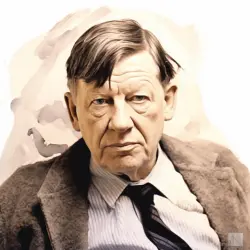




The poem is a morose, sad elegy that wonderfully describes the feelings associated with grieving. It’s filled with clever twists and heart-wrenching statements that give it a real poignancy, features that may explain the poem’s enduring popularity. It showcases Auden’s poetic ability to relate to human emotions.
Auden’s ‘Funeral Blues’ beautifully captures the essence of grief, mourning, and death. This piece is about a speaker mourning the loss of their loved one and piecing themselves together without any fruition. Some of the salient features of the poem include but are not limited to the following. It is important to know them before diving deeper into the poem.
- The Title: The title of Auden’s poem, ‘Funeral Blues,’ also known as ‘Stop all the clocks,’ signifies a poetic piece that conforms to the blues (melancholic music of African-American folk origin) tradition and meant to be sung or recited at a funeral.
- Diction: Auden uses clever word choice in order to voice the speaker’s grief over the death of their loved one. The diction gives this piece a somewhat urban outlook, depicting a person ordering people to empathize with his state of mind.
- Structure: There is a specific structure as well as a rhyming scheme (AABB) in this poem. The meter, however, shifts a bit to accommodate the speaker’s tone and mood.
- Central Message: There is a strong message essential to understand the purpose of writing this piece. Though it appears to be a lament on some incurable loss, at its core, it depicts how one cannot fill the void created by a loved one’s death.
Log in or join Poetry+ to access unlimited Poem PDFs.

Funeral Blues W.H. AudenStop all the clocks, cut off the telephone, Prevent the dog from barking with a juicy bone, Silence the pianos and with muffled drum Bring out the coffin, let the mourners come.Let aeroplanes circle moaning overhead Scribbling on the sky the message He Is Dead, Put crepe bows round the white necks of the public doves, Let the traffic policemen wear black gloves.He was my North, my South, my East and West, My working week and my Sunday rest, My noon, my midnight, my talk, my song; I thought that love would last forever: I was wrong.The stars are not wanted now: put out every one; Pack up the moon and dismantle the sun; Pour away the ocean and sweep up the wood; For nothing now can ever come to good.

 Get PDFs
  Fully understand this poem faster with a
Poetry+
membership and get the core resources you need in one place
Fully understand this poem faster with a
Poetry+
membership and get the core resources you need in one place
Summary
‘Funeral Blues‘ by W.H. Auden is about the power of grief and the way that it influences people differently.
For someone like the speaker who has suffered a loss, the world is transformed. But to everyone else, nothing changes. Time doesn’t slow down, and no one cares what’s happening. The indifference of the world plagues the speaker in this poem. They plead with the world to feel as they do, understand his grief, and even participate in it.
Expert Commentary

Insights by Sudip Das Gupta
First-class B.A. Honors Degree in English Literature
Structure and Form
‘Funeral Blues,’ is a classic elegy. While the narrator does not go into specific detail about the loss suffered, the feelings of loss are very present. Auden structured the poem in four, four-line stanzas known as quatrains, following a rhyme scheme of AABB. It is an atypically somber poem and is, therefore, a popular reading at funerals. Most of the poem is delivered through an omniscient, anonymous narrator. But as the lines go on, the amorphous loss becomes more personal as the speaker makes use of first-person pronouns. Other than that this piece is written in iambic pentameter with a number of metrical variations. It shifts from the regular pattern in order to depict the shifting state of mind of the speaker while trying to grasp the enormity of the loss.
Tone and Mood
Being an elegy or typically a lament for a dead individual, ‘Funeral Blues’ builds up a sad and serious mood from the very beginning of the poem. It depicts the state of mind of a mourner who is unable to piece together the loss that he has suffered. Furthermore, the tone of the poem reflects a sense of anguish and bitter sadness for the people around the speaker did not reciprocate the speaker’s feelings. They could not even stop a bit in order to empathize with the speaker. This is why the speaker is frustrated and angry throughout the poem. At last, he somehow tries to point out the futility of his mourning by saying “For nothing now can ever come to any good.”
Literary Devices
Within ‘Funeral Blues’ Auden makes use of several poetic techniques. These include but are not limited to caesura, anaphora, alliteration, enjambment, and hyperbole.
- Caesura: The first, caesura, occurs when a line is split in half, sometimes with punctuation, sometimes not. For example, it occurs in the fourth line of the first stanza, as well as the fourth line of the third stanza.
- Alliteration: Another important and common technique within Auden’s works is alliteration, and it occurs when words are used in succession, or at least appear close together, and begin with the same letter. For instance, in the first line of the first stanza: “the clocks, cut off” or “working week” in the second line of the third stanza, there is a repetition of the same sound at the beginning of neighboring words.
- Anaphora: Auden also makes use of anaphora, or the repetition of a word or phrase at the beginning of multiple lines, usually in succession. This appears sporadically throughout the text; for example, “Let” at the beginning of lines one and four of the second stanza and “My” at the start of lines two and three of the third.
- Hyperbole: Towards the end of the poem, hyperbole becomes quite important. It is an intentionally exaggerated description, comparison, or exclamation meant to further the writer’s important themes or make a specific impact on a reader. The last lines ask the impossible, that one should “Pack up the moon and dismantle the sun” and “put out” the stars.
- Enjambment: Another important technique commonly used in poetry is enjambment. It occurs when a line is cut off before its natural stopping point. Enjambment forces a reader down to the next line, and the next, quickly. One has to move forward in order to comfortably resolve a phrase or sentence. It can be seen throughout the poem, but a few examples include the transition between lines three and four of the first stanza and lines one and two of the second stanza.
- Imagery: Auden presents several images that help to convey the poem’s central themes which include silence, grief, and mourning. For instance, readers come across the auditory images of ticking clocks, a telephone, a barking dog, a piano played by someone, and the muffled drum beating at the onset of a funeral procession.
- Symbolism: There are a number of important symbols in the poem that are used to refer to an idea or concept related to them. For instance, in the first line, the “clocks” symbolize time. In the second stanza, the “public doves” are symbolic of peace.
- Metaphor: In the third stanza, Auden uses a metaphor to compare the deceased person to a compass. It signifies that the person while alive acted as a guiding spirit for the speaker.
Themes
There are several important themes in W.H. Auden’s‘Funeral Blues’. These include grief/silence, isolation, and death. All three of these themes are tied together within the text as the speaker discusses what grief over the death of a loved one is like and how it separates one from the rest of the world. In the first lines, the speaker demands that everything quiet down and that all the “mourners come” to mourn. The speaker seeks out transformation in the world but is unable to find it. They are isolated in their loss and no one adequately respects that fact.
Analysis, Stanza by Stanza
Stanza One
‘Stop all the clocks, cut off the telephone’
Stop all the clocks, cut off the telephone,
Prevent the dog from barking with a juicy bone,
Silence the pianos and with muffled drum
Bring out the coffin, let the mourners come.
What a powerful way to start a poem. The idea of stopping the clocks serves two purposes here. First, it stops the noise that they potentially make, the annoying ticking sound, but also it signifies the stopping of time. When somebody dies their time is said to be up and this represents that. That is followed up with “cut off” the telephone, the poet could have used the word disconnect, but the idea of being “cut off” acts as a subtle double entendre.
There is an ever-present theme of stopping sounds and promoting silence, hence preventing the dog from barking. In fact, that seems to be the overarching theme of this first stanza. Silence is the order of the day. What is interesting is the idea of silencing the piano with a muffled drum. I think the drum referenced here isn’t an actual drum. Rather, it is a representation of the footsteps of pole bearers as the next line in the stanza references the arrival of the coffin. It is feasible the marching action performed by these men could elicit the experience of a drum beat. Interestingly, the stanza ends with the phrase “let the mourners come,” an invitation of sorts.
Stanza Two
Let aeroplanes circle moaning overhead
Scribbling on the sky the message ‘He is Dead’.
Put crepe bows round the white necks of the public doves,
Let the traffic policemen wear black cotton gloves.
Auden is meticulously clever in the language that he uses. Once again in this stanza, he makes reference to noises. This time though he describes the airplanes as “moaning”. The first thing of importance to note is that the sound of the word “moaning” sounds a lot like the word mourning. But, it is also a noise associated with death or dying. This clever word choice is a feature of Auden’s poetry and can be seen throughout ‘Funeral Blues’.
The next line has an element of the surreal about it. Suggesting that a plane could use its chemical trails to write anything as complex as that is pretty unrealistic. I think this line is more about displaying the narrator’s feelings though. There is an element of “for all I care” about this line as if the narrator doesn’t want to deal with anything and just everything to go away as quickly as possible.
In the next line of ‘Funeral Blues,’ the narrator evokes the image of the “dove”. The dove is a powerful icon, especially from a religious standpoint. It represents purity and peace, drawing us back to the narrator’s desire for quiet. What is notable though is this is slightly subverted. Auden uses “public doves.” Could he be referencing the common pigeon through this phrase? Is the suggestion here that he wants a commonplace animal to dress formally and pay its respects, to signify that the loss of this person is a loss to everybody? The next line suggests so as it recommends that even the traffic police should be in mourning. Wearing black gloves would be a sign of respect to the departed.
Stanza Three
He was my North, my South, my East and West,
My working week and my Sunday rest,
My noon, my midnight, my talk, my song;
I thought that love would last forever: I was wrong.
This stanza of ‘Funeral Blues’ talks explicitly about what the person they are mourning means to them. The opening line references the points of a compass and carries the suggestion of a loss of direction. The speaker is lost, physically and emotionally, without their partner.
The next line furthers the importance of the deceased. It is the narrator’s way of saying that this person meant everything to them. The third line emphasizes this. By stating they have lost their “talk” and their “song,” they are once again bringing the poem back to the theme of silence that has reoccurred throughout the poem. It is clear from the last line of the stanza that the narrator loved the person they are referencing dearly and that they thought that emotion would last forever. It has clearly been replaced by grieving.
Stanza Four
The stars are not wanted now; put out every one,
Pack up the moon and dismantle the sun,
Pour away the ocean and sweep up the wood;
For nothing now can ever come to any good.
The opening line to the final stanza of ‘Funeral Blues’ is among the more striking in the entire poem. It describes the listless feeling one experiences when everything seems pointless and irritating. The stars represent hope and love and the narrator has no interest in these things at this point. Their grieving has put them in a, figuratively, very dark place. The theme of darkness continues as they then talk about dismantling the heavens. They truly feel that they cannot continue now they have lost their loved one.
The melodrama of the narrator’s emotions in ‘Funeral Blues’ peaks with the penultimate line as they suggest doing away with the oceans. It is clear that they feel that now the person that they are mourning has been removed from their lives that they will never enjoy happiness again. This is extremely powerful and emotional material and anyone who has suffered a tragic loss will no doubt be able to relate to the content of this poem.
Historical Context
‘Funeral Blues’ was first written in April 1936 for the play The Ascent of F6 by W. H. Auden and Christopher Isherwood. It was meant to be a satiric piece lamenting the loss of a political figure appearing in the play. From then onwards, the text underwent several changes to become a four-stanza poem comprising four lines each. The text is referenced often in film and TV, such as in Four Weddings and a Funeral (1994) and Gavin and Stacey (2007). Auden rewrote this piece as a cabaret song meant for the singer Hedli Anderson. The first version of the text included five stanzas. Auden later replaced the last three stanzas with two newly written ones and did not change the first two stanzas. This version was first published in the poetry anthology Poems of To-Day (1938) and also in The Year’s Poetry, 1938.
About W.H. Auden
Wystan Hugh Auden was born in England but later became a citizen of the United States. He is a divisive figure although most scholars recognize his importance as one of the most renowned poets of the twentieth century they are often critical of his style and of his importance. Auden’s poems cover a wide range of topics from politics, religion, love, and social issues. He has a large back catalog of work and also wrote plays/films as well as poems. He was also a prolific essayist.
FAQs
W. H. Auden’s ‘Funeral Blues’ touches the readers deeply as it conveys the central idea without any extra refinement. It presents the raw emotions of a speaker who is trying to cope with the loss that he has suffered. On top of that, this piece has a universal outlook signifying an irrevocable loss that is experienced by all at some point. People go through a similar mental state when they lose someone dear to them. For these manifold reasons and appearances in popular media, this poem has become so famous and will remain so.
When ‘Funeral Blues’ was first written for the play The Ascent of F6, it was meant to be a lament for the death of a political leader, a character from the play. In the final 1938 version of the poem, Auden revised the text in order to take it out of the context of the play and give it a universal outlook. Therefore, both the speaker and the person for whom this elegy is written are unnamed. The deceased could be someone the speaker loved and cared about deeply.
The title directly embodies the subject matter and the central idea of the poem. This piece is written in line with the blues tradition and it is meant for the funeral of someone close to the speaker. Apart from that, the blues works are universal in nature depicting the sadness that grasps all. This piece by Auden also reflects the commonality of loss and grief experienced by all.
The main irony or understatement in the poem appears in the last line of the poem that reads, “For nothing now can ever come to any good.” This line questions the purpose of writing this piece which is mourning the loss of a loved one. If nothing good can come after such heartfelt mourning, it is futile to tell everyone around to gather to witness the funeral of the speaker’s loved one.
Auden wrote the poem ‘Funeral Blues,’ also known as ‘Stop All the Clocks’ for the play written in collaboration with Christopher Isherwood entitled The Ascent of F6, published in 1936. In the context of the play, this poem serves as a mourning song for a political leader who appears in the play. Later, Auden revised the poem in order for everyone to relate to the content.
Similar Poetry
Here is a list of poems that tap on similar themes and ideas present in Auden’s best-known work, ‘Funeral Blues’:
- ‘O Captain! My Captain!’ by Walt Whitman: This poem is written in memory of one of the great American presidents, Abraham Lincoln who died in 1865.
- ‘Lycidas’ by John Milton: Milton wrote this piece to memorialize the death of his friend, Edward King.
- ‘Oh! Snatched Away in Beauty’s Bloom’ by Lord Byron: This poem is an attempt at finding catharsis in grief.
- ‘Aunt Helen’ by T. S. Eliot: This poem depicts the life and death of the speaker’s aunt.
Explore some of the best-known poems to read at funerals.