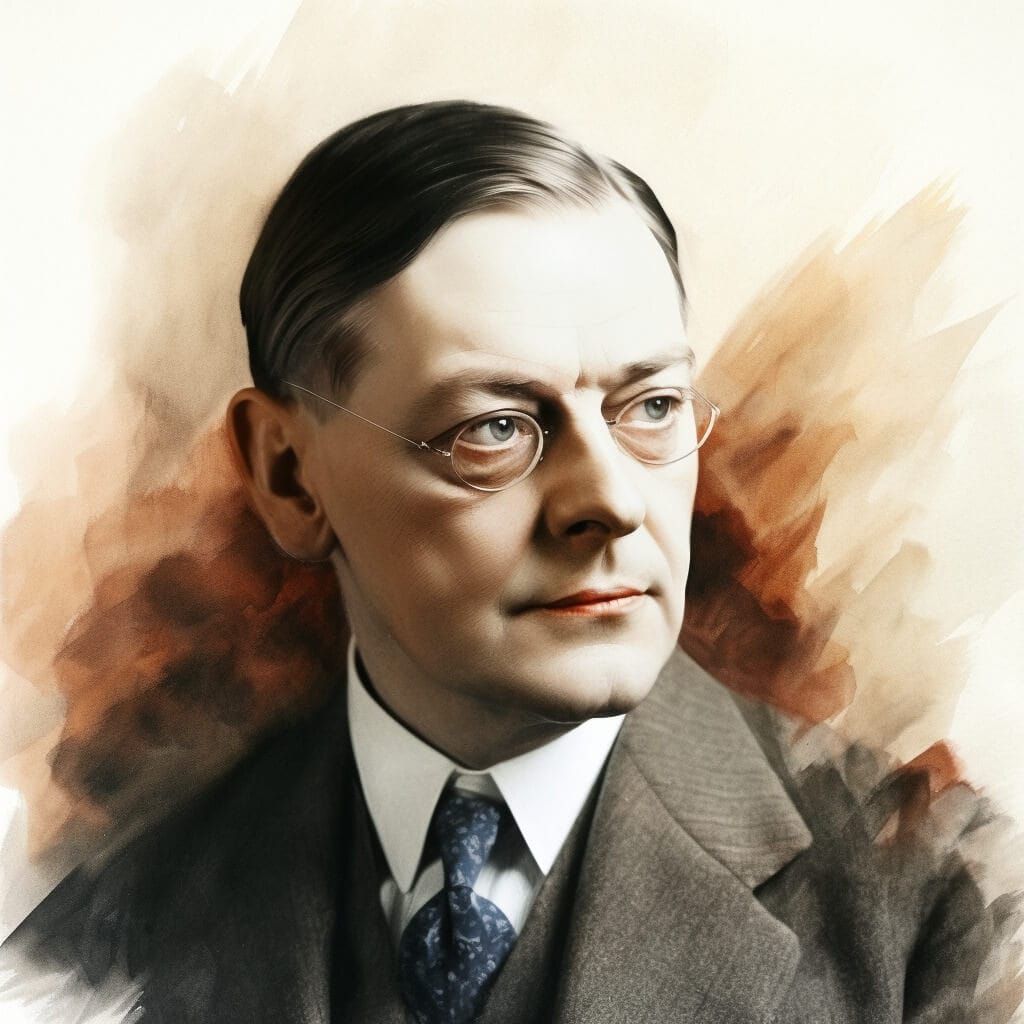
T.S. Eliot

20+ T.S. Eliot Poems

(15 to start, 20+ to explore)

Related Tags:
#1

The Waste Land

‘The Waste Land,’ epitomizing literary modernism, is one of the most important poems of the 20th century, portraying its despondent mood.

'The Waste Land,' one of T.S. Eliot's best works, masterfully exemplifies its era, his unique poetic style, and literary theories. Renowned for its complexity and fragmented structure, it skillfully employs literary, cultural, historical, mythological, and religious allusions. This richly allusive poem vividly captures the alienated, spiritually barren, and culturally confused world of the post-war 20th Century, epitomizing Eliot's sophisticated approach to poetry, as discussed in his essay 'The Metaphysical Poets.'

April is the cruellest month, breeding

Lilacs out of the dead land, mixing

Memory and desire, stirring

Dull roots with spring rain.

#2

The Hollow Men

‘The Hollow Men’ presents the hollow, degenerated, and disillusioned people dealing with their meaningless existence amidst the ruins of the postwar world.

'The Hollow Men' depicts men in a desolate world, symbolizing their barren existence through imagery of broken columns, glass, and stones. The poem, evoking images of heaven and a shadowy presence, is narrated by a collective speaker. These men, likened to scarecrows, are trapped between life and death in a world where they lack control. Unable to embrace death, as they cannot cross the river, they await a transformative change.

We are the hollow men

We are the stuffed men

Leaning together

Headpiece filled with straw. Alas!

#3

The Love Song of J. Alfred Prufrock

Breaking away from Victorian diction, T.S. Eliot presents the distinct realities of his time in the stream of consciousness by experimenting with poetic form.

'The Love Song of J. Alfred Prufrock', written early in Eliot's career, established his reputation and eventually became one of the defining poems of literary modernism. Eliot's famous allusive method in the poem focuses on Dante's 'Divine Comedy' while portraying modern-day society as 'Inferno' or hell. In 1950, Eliot described Dante "as the most persistent and deepest influence upon my own verse." Eliot's poems are known to convey the decadence of the modern world.

Let us go then, you and I,

When the evening is spread out against the sky

Like a patient etherized upon a table;

Let us go, through certain half-deserted streets,

#4

Burnt Norton

‘Burnt Norton’ explores the philosophical concepts of time, spirituality, and transcendence, focusing on the human quest for higher meaning.

'Burnt Norton,' the earliest and first poem in Eliot's 'Four Quartets,' marks a shift from 'The Waste Land's' hopelessness, introducing key themes like cyclic time and salvation. Unlike the fragmented allusions in 'The Waste Land,' this poem weaves complex allusions into a unified collage. It also references Eliot's 'Murder in the Cathedral,' written simultaneously, showcasing his characteristic allusive style while foregrounding major thematic concerns of 'Four Quartets.'

Time present and time past

Are both perhaps present in time future,

And time future contained in time past.

If all time is eternally present

#5

Ash Wednesday

In rich poetic language, ‘Ash Wednesday’ presents the spiritual struggle of an alienated individual lacking faith in decayed modern culture.

'Ash Wednesday' is Eliot's first major long poem after his conversion to Anglicanism from Unitarianism in 1927. The poem, often known as "conversion poem," marks the shift in Eliot's poetic style and subject, which continued to move from fragmented narratives to lyrical wholes exuding optimism and hope for modern humanity instead of hopelessness and pessimism. Nonetheless, Eliot continued to use his complex allusive method and modernist techniques taking his artistic capabilities to new heights.

Because I do not hope to turn again

Because I do not hope

Because I do not hope to turn

Desiring this man's gift and that man's scope

#6

Sweeney among the Nightingales

‘Sweeney Among the Nightingales’ reflects the modern world’s degraded state through its layered allusions, symbolism, and imagery.

Sweeney is a popular character that Eliot uses to explore dehumanization, moral and sexual debasement, alienation, and disillusionment of modern urban men. 'Sweeney Among the Nightingales' is the most well-known and one of the earliest poems of Eliot centered on Sweeney's character. The poem follows Eliot's allusive method and refers to literary and cultural sources. Eliot even mentioned the poem in his famous essay 'Tradition and Individual Talent' (1919), stating that the poem refers to the "passages of the greatest poetry."

Apeneck Sweeney spread his knees

Letting his arms hang down to laugh,

The zebra stripes along his jaw

Swelling to maculate giraffe.

#7

Gerontion

Once considered as a preface to the major poem ‘The Waste Land’ by T.S. Eliot, ‘Gerontion’ effectively deals with the huge psychological, spiritual, and physical destruction caused by the great war.

'Gerontion,' thematically focused on postwar decay and fragmentation, foreshadows Eliot's 'The Waste Land,' published two years later. Eliot thought of including it as a preface to 'The Waste Land.' The poem stands out for its personal, contemplative depiction of the postwar world, exploring philosophical and theological themes that later appear in works like 'Ash Wednesday.' Unlike the more vivid portrayal of global horror in 'The Waste Land,' 'Gerontion' offers a more contemplative or lamenting approach in a shorter format.

Here I am, an old man in a dry month,

Being read to by a boy, waiting for rain.

I was neither at the hot gates

Nor fought in the warm rain

#8

Portrait of a Lady

The speaker of the poem observes the older lady to be callous as he hangs out with her, only to find out he himself is indeed emotionally desolate and callous.

'Portrait of a Lady' is one of the early poems that established Eliot's reputation in the intellectual and literary world of the early 20th Century. The poem anticipates thematic concerns and complex forms seen later in Eliot's most significant postwar works. Like 'The Love Song of J. Alfred Prufrock,' this poem deals with meaningless modern urban life and decadence with the idea of unrequited love in the background. Distinctively, 'Portrait of a Lady' focuses on the woman, presenting her as trapped in meaningless and superficial urban life.

Among the smoke and fog of a December afternoon

You have the scene arrange itself โ€” as it will seem to doโ€”

With 'I have saved this afternoon for you';

And four wax candles in the darkened room,

#9

Rhapsody on a Windy Night

‘Rhapsody on a Windy Night,’ with its spooky mood and setting, captures the tortured and fragmented human psyche amidst a destructed world.

'Rhapsody on a Windy Night' is one of the early poems that established Eliot's reputation. As Eliot became one of the prominent voices of the 20th Century, 'Rhapsody on a Windy Night' gained vast literary importance. The poem distinctively explores mind, time, and memory in the decadent modern world as the speaker wanders on an urban street late at night. Eliot carries the theme of the decadent modern world in most of his poems.

Twelve o'clock.

Along the reaches of the street

Held in a lunar synthesis,

Whispering lunar incantations

#10

Journey of the Magi

‘Journey of the Magi’ shows the Magi’s transformative spiritual journey as he grapples with a new spiritual reality.

'Journey of the Magi,' a notable poem from Eliot's 'Ariel' collection, reflects on religion and spiritual growth, themes prevalent in his post-conversion to Anglicanism works. Published in 1928, Eliot's conversion influenced his writing, as seen in his declaration in 'For Lancelot Andrewes' of being a "classicist in literature, royalist in politics, and Anglo-catholic in religion." Despite this shift, 'Journey of the Magi' retains Eliot's familiar themes of alienation, the ambiguity of the modern world, and his characteristic use of allusion.

A cold coming we had of it,

Just the worst time of the year

For a journey, and such a long journey:

The ways deep and the weather sharp,

#11

Sweeney Erect

‘Sweeney Erect’ presents the complex and ambiguous state of Sweeney, in turn questioning civilization’s state in the modern world.

'Sweeney Erect', published in Eliot's 'Poems' (1920) collection, is one of the significant works wherein he uses Sweeney's character. Eliot uses the character of Sweeney in a few of his works to explore the themes of dehumanization, moral and sexual debasement, alienation, and disillusionment of men amidst the uncertain and culturally degraded modern world; 'Sweeney Erect' explores similar themes with rich allusions featuring Eliot's characteristic allusive method.

And the trees about me,

Let them be dry and leafless; let the rocks

Groan with continual surges; and behind me

Make all a desolation. Look, look, wenches!

#12

The Dry Salvages

In โ€˜The Dry Salvages,โ€™ Eliot contemplates life’s complexities, merging human existence with cosmic forces, offering profound insights into the human soul’s journey.

This poem is a quintessential representation of T.S. Eliot's poetic style and themes. It embodies his characteristic exploration of complex philosophical and spiritual concepts, intricate use of symbolism and imagery, and deep reflections on the human condition. The poem's meditative tone, profound insights, and rich language are consistent with Eliot's body of work, making it a prime example of his distinctive poetic voice and thematic concerns.

I do not know much about gods; but I think that the river

Is a strong brown godโ€”sullen, untamed and intractable,

Patient to some degree, at first recognised as a frontier;

Useful, untrustworthy, as a conveyor of commerce;
#13

Preludes

‘Preludes’ is a chilling exploration of life amidst urban decay, alienation, and absence of meaning in the dark modern world.

'Preludes' is one of the earliest poems of T.S Eliot, written during 1910-11 and published in Eliot's first collection 'Prufrock and Other Observations' (1917), which established his reputation in the literary world. 'Preludes' explores urban decay, spiritual and moral desolation, and the degraded modern world anticipating major poems like 'The Waste Land' and 'Gerontion'. The poem carries Eliot's allusive method, starking grim urban imagery, and modernist techniques.

The winter evening settles down

With smell of steaks in passageways.

Six oโ€™clock.

The burnt-out ends of smoky days.

#14

Landscapes IV: Rannoch by Glencoe

โ€˜Landscapes IV: Rannoch by Glencoeโ€™ layers natureโ€™s barrenness with historical trauma in the Scottish Highlands.

The poem reflects Eliotโ€™s modernist method of investing landscapes with cultural memory and historical weight. Like in 'The Waste Land', place becomes a palimpsest of violence and inherited trauma. The fractured free verse and stark imagery reflect his break with traditional form, while calling up ancient wars echoes his preoccupation with the how history persists in the present. Critics note Eliotโ€™s landscapes are never neutral: in this case, a rugged landscape bears collective memory of violence.

Here the crow starves, here the patient stag

Breeds for the rifle. Between the soft moor

and the soft sky, scarcely room

To leap or to soar. Substance crumbles, in the thin air

#15

Marina

‘Marina’ presents the joy of the spiritual awakening of a lost individual, offering hope to the readers living in a desolate modern world.

'Marina' is one of the most important 'Ariel' poems of Eliot. After his conversion to Anglicanism, Eliot wrote a series of short poems for Faber & Gwyer (Faber & Faber later) called the Ariel series. The poem is often considered a spiritual meditation dealing with spiritual crises while articulating feelings of religious awakening, anticipating the much-celebrated longer poem 'Four Quartets.' 'Marina' like 'Ash Wednesday' exemplifies Eliot's post-conversion style.

What seas what shores what grey rocks and what islands

What water lapping the bow

And scent of pine and the woodthrush singing through the fog

What images return

(and also get exclusive PDFs on poetry, plus much more)

Unlock the Secrets to Poetry

Close the CTA

1.2k+ Reviews

Poetry PDF Guides and Printables
Star half empty
Star icon
Star icon
Star icon
Star icon

Access Poetry PDF Guides for this Poem

Complete Poetry PDF Guide

Covers All You Need to Know

One-pager 'snapshot' PDF

Great Offline Resource

Gateway to deeper learning

1.2k+ Reviews

Close the CTA

Perfect Offline Resource

10-Question Quiz PDF

Answer Key with Explanations

Great to test poem knowledge

Choose the format that fits your learning style.

Poem PDF Guides Visualisation
Poetry Snapshot PDF Wireframe
Poem Quiz PDF Wireframe
Access thousands more Poem PDFs in our library โ†—